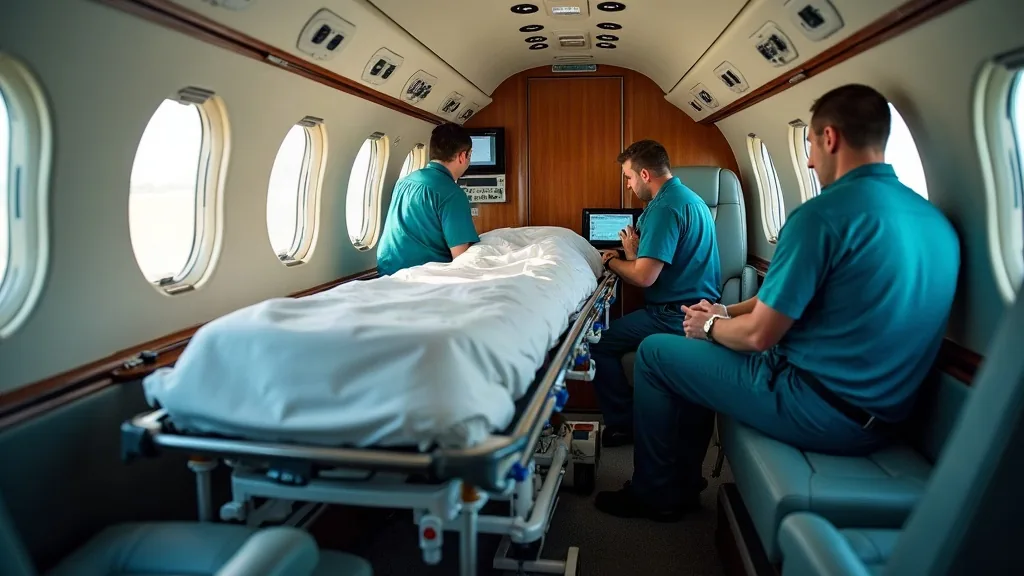
A corporate medevac retainer is an annual standby agreement that pre-registers a company’s sites, staff and evacuation routes with an independent coordination desk, so activation starts within minutes of a call instead of researching operators mid-emergency. It combines a fixed annual desk fee with per-activation operator costs quoted case by case, confirmed at a scoping call — never sold as a fixed national tariff.
Indonesia has multiple private and government medevac providers but, per the 2024 readiness study Indonesian air medical evacuation: analyzing readiness and proposing an integrated standard procedure, no single regulation definitively governs air medevac procedure or stakeholder integration nationwide. For a company running remote sites — a mine in Kalimantan, a dive resort off Raja Ampat, a film shoot in Mentawai, an NGO camp in Papua — that gap is exactly what a standby retainer is built to close before, not during, an emergency.
What Does a Standby Retainer Include?
A retainer through Juara Holding Group’s coordination desk is a planning-and-activation service, not an ambulance fleet. The desk does not own aircraft or clinics; every evacuation is arranged with licensed operators at the time of activation. Core components:
- Pre-registered sites. GPS coordinates, nearest airstrip (Sorong DEO or Waisai for Raja Ampat, Labuan Bajo LBJ for Komodo liveaboards, Balikpapan BPN or Pontianak for Kalimantan mining, Padang PDG or Tuapejat for Mentawai, Timika, Jayapura-Sentani or Wamena for Papua), and road/water access notes logged before any incident occurs.
- An evacuation ladder. A tiered decision path — on-site first aid, nearest hospital, inter-island transfer, international repatriation — matched to case severity, so the company’s site manager isn’t improvising the chain of custody at 2am.
- 24/7 activation line. A single number the site manager calls; the desk relays to vetted licensed operators and confirms who is moving, from where, to where.
- Insurer and assistance-company liaison. The desk holds the company’s insurer/assistance-company contact details on file and coordinates authorisation calls in parallel with operator dispatch, rather than sequentially.
- Annual drill. A tabletop or live run-through once a year so the ladder isn’t read for the first time during a real case.
None of this substitutes for the company’s own insurance or assistance-company contract — it sits alongside it, closing the coordination gap between “something happened” and “an operator is airborne.”
How Is a Corporate Medevac Retainer Priced?
Two separate cost lines, and they should never be quoted as one number.
- Annual desk fee — what the company pays Juara Holding Group to hold its sites on file, staff the 24/7 line, run the annual drill and liaise with the insurer. This is the desk’s own coordination fee, confirmed at the scoping call and indicative only until sites and headcount are scoped.
- Per-activation operator cost — what the licensed operator charges for the actual evacuation (aircraft type, distance, crew, hospital-to-hospital handoff). This is quoted case by case at the time of activation because no public dated tariff table exists across Indonesian providers; distance, aircraft availability and time of day all move the number.
| Retainer Tier | Sites Covered | Indicative Annual Desk Fee (2026) | Activation Cost |
|---|---|---|---|
| Single-site | 1 fixed location | Per the desk’s indicative figures, confirmed at scoping call | Quoted per case |
| Multi-site | 2–6 fixed locations | Per the desk’s indicative figures, confirmed at scoping call | Quoted per case |
| Expedition season | 1 mobile route, 3–6 months | Per the desk’s indicative figures, confirmed at scoping call | Quoted per case |
Figures above are indicative starting bands for budgeting, as of 2026, subject to change — confirmed only after the scoping call reviews headcount, site count, season length and existing insurer coverage.
What Is the Employer’s Duty Under Health Law 17/2023 and Permenkes 14/2021?
Health Law 17/2023 obliges health professionals and health facilities to give first aid in emergencies and disasters — a duty that shapes how site clinics and contracted hospitals must respond, and which a retainer’s evacuation ladder should be built around rather than around. Permenkes 14/2021 governs risk-based licensing across the health sector, which is why the desk arranges only with operators and facilities holding the relevant business licences rather than informal charter arrangements.
For a company operating a remote site, this translates into a practical duty: know in advance which licensed facility receives a casualty, at what point a case escalates beyond on-site capability, and who authorises transport. A retainer documents that chain before an incident, which is the operational answer to a regulatory obligation that otherwise sits unaddressed in a standard employment contract.
Transport itself sits under PM 66/2015: foreign aircraft need Minister of Transportation flight approval after diplomatic and security clearance, but Article 16 exempts medical evacuation, humanitarian and VVIP flights from certain Article 15 provisions, which is what allows a genuine medevac case to fast-track approval rather than queue behind routine charter slots.
How Do Expedition and Seasonal Retainers Differ From Year-Round Mining Cover?
A mining or plantation site runs the same headcount, same clinic, same evacuation ladder twelve months a year — the retainer is priced and drilled once and stays static until headcount changes. An expedition, film shoot or dive-liveaboard season is the opposite: the crew, the route and the nearest airstrip change week to week, so the desk scopes a moving evacuation ladder tied to the itinerary rather than a fixed GPS pin.
The Ministry of Health has mobilised six helicopter air ambulances for 3T (frontier, outermost, underdeveloped) regions, with Health Minister Budi Gunadi Sadikin stating they already operate in Papua — relevant context for expedition routing through those regions, though the desk still confirms current government-asset availability case by case rather than assuming coverage. Named private providers such as Indo Jet Medic advertise 24-hour call coverage across Bali, Nusa Tenggara, Sulawesi, Sumatra, Java, Kalimantan, Papua and Ambon, with helicopter evacuation limited to daytime hours (06:00–18:00 local), which is why a night-transit expedition route needs its ladder planned around that window rather than assumed continuous.
KPIs a Company Should Track on Its Retainer
| KPI | What It Measures | Why It Matters |
|---|---|---|
| Time-to-decision | Minutes from call-in to evacuation-ladder decision | Shows whether the pre-registered plan is actually being used |
| Time-to-wheels-up | Minutes from decision to operator departure | The number insurers and site managers care about most |
| Insurer authorisation time | Minutes/hours from case notification to insurer sign-off | Flags where the liaison step is or isn’t saving time |
How Booking a Retainer Works
- Scoping call. WhatsApp or email the desk with headcount, site count, season length and current insurer/assistance-company contact.
- Draft plan. The desk drafts the evacuation ladder and site registration sheet and sends it back for review — nothing is billed at this stage.
- Retainer confirmed. Annual desk fee agreed, sites logged, 24/7 line activated, annual drill scheduled.
- On file, not on standby idle. The desk holds the plan and contacts on file; activation only occurs when the company calls, and every activation arranges licensed operators — the desk never guarantees outcome, arrival time or aircraft availability, since those depend on operator capacity at the moment of the call.
Juara Holding Group is an independent coordination desk and broker, operating since 2015 — not an air ambulance operator, not affiliated with any named provider above, and not a licensed insurer. Every evacuation is arranged with vetted licensed operators at the time of activation. For companies and expeditions covering Bali and the immediately surrounding islands, the equivalent desk is balimedevac.com; this desk’s remit is national and international coordination.
Ready to scope a retainer for your sites? Message the concierge desk on WhatsApp at 6281139414563 or email bd@juaraholding.com with headcount, site locations and your current insurer — the desk will draft your evacuation ladder for review at no cost before any retainer is confirmed.
Frequently Asked Questions
What size company actually needs a corporate medevac retainer instead of ad hoc arrangements?
Any employer running one or more remote or hard-to-reach sites — a single mine camp, a dive liveaboard fleet, a multi-site plantation — benefits once the cost of researching an operator mid-emergency outweighs an annual desk fee. Companies with fewer than 10 remote staff sometimes still retain purely for the pre-registered evacuation ladder and insurer liaison, not headcount volume.
Does a corporate retainer cover contractors and short-term visitors, or only permanent staff?
Coverage is defined at the scoping call, not fixed by default. Most retainers list permanent site staff plus rotating contractors and visiting auditors by headcount band, updated as rosters change. Film crews and expedition guests are typically added per season rather than per individual, confirmed in the multi-site or expedition tier agreement.
Can a corporate retainer include international repatriation, or only domestic inter-island transfer?
Yes — the retainer’s evacuation ladder can extend to international legs (Bali or Jakarta to Singapore, Kuala Lumpur, Penang, Bangkok or Australia, arranged via networks such as CareFlight for Australian cases), but international repatriation is priced and authorised separately at activation, since it depends on the receiving hospital, insurer sign-off and aircraft type at the time.
How fast can a retainer be activated after enrollment, and is there a waiting period?
The 24/7 activation line and site registration are live as soon as the desk fee is confirmed and sites are logged — typically within days of the scoping call, not months. There is no medical waiting period comparable to an insurance policy, because the retainer is a coordination service, not a claims product.
Does JHG replace the company’s existing insurance or assistance-company coverage?
No. The retainer sits alongside existing insurance or assistance-company arrangements and liaises with them during activation; it does not replace a policy, guarantee authorisation, or act as the insurer. Companies without existing medevac-capable insurance should still retain, since the ladder and 24/7 line function independently of any policy in place.