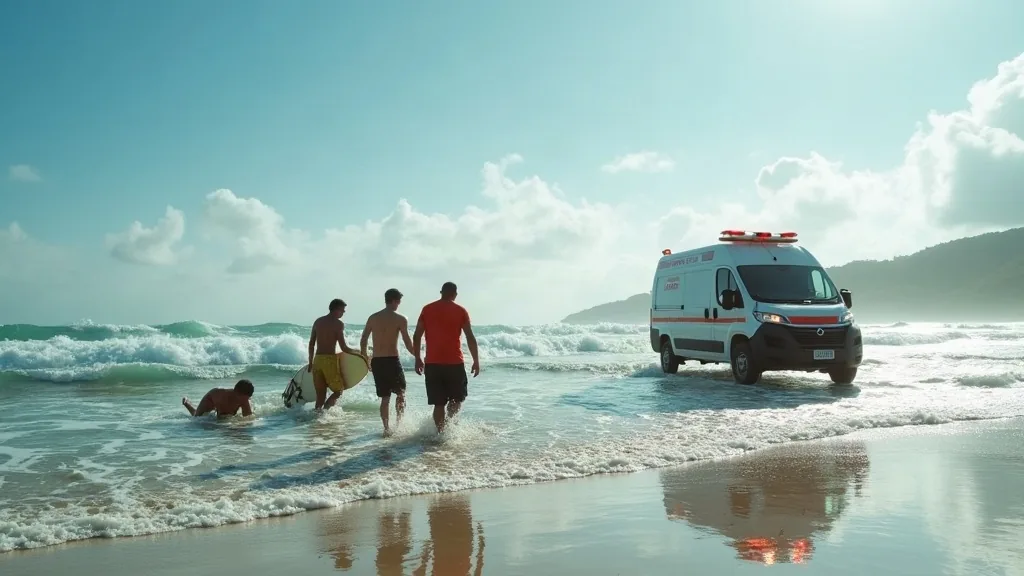
A Mentawai surf injury reaches definitive care through a fixed chain, not a single flight: onboard stabilization, boat transfer to Tuapejat or straight to Padang, then an air leg from Padang (PDG) toward Jakarta, Singapore or Australia depending on severity. Juara Holding Group runs this as an independent coordination desk — pre-registering charter vessels, arranging fit-to-fly sign-off, and sourcing licensed air transport. It does not own boats, helicopters or hospitals.
How does a surf injury on a charter reach a hospital: boat to Tuapejat or Padang, then air?
There is no single national medevac authority in Indonesia coordinating this chain end to end — a 2024 readiness study on Indonesian air medical evacuation concluded that no regulation definitively governs air medevac procedure or stakeholder integration, so each case is assembled operator by operator. For a Mentawai charter, that means three linked decisions made in sequence, usually inside the first 30–60 minutes after injury.
First, the boat crew stabilizes on deck or in the cabin and calls the standby desk with GPS position, injury description and estimated time to shore. Second, the captain chooses a landing point: Tuapejat (Sipora) has an airstrip and ferry terminal but limited hospital capacity, while continuing direct to Padang by boat is longer but lands the patient at a city with a fuller hospital bench and more onward air options. Third, once ashore, a Padang hospital performs the assessment and issues (or withholds) fit-to-fly clearance — the concept set out in Decree of the Minister of Health 882/Menkes/SK/X/2009, which also defines the roles of flight doctors, air nurses and attendants on the transport leg. Indonesian law also backs the receiving side of this chain: Health Law 17/2023 obliges health facilities and professionals to give first aid in emergencies regardless of upfront payment status, which matters for a foreign surfer arriving without local insurance paperwork in hand.
| Leg | Typical mode | Indicative duration* |
|---|---|---|
| Injury site to Tuapejat | Charter vessel / support boat | Roughly 1–4 hours, camp-dependent |
| Injury site direct to Padang | Charter vessel, open-water transit | Roughly 8–14 hours, sea-state dependent |
| Tuapejat to Padang | Fast ferry or scheduled boat | Roughly 2.5–4 hours in calm seas |
| Padang to airport transfer for evacuation | Hospital to PDG apron | Under 1 hour, traffic-dependent |
| Helicopter lift (where available) | Daylight only | Subject to 06:00–18:00 local window |
*Bands reflect operator practice reported in the market as of 2026, not a fixed schedule; actual times move with sea state, vessel type and camp location. Indo Jet Medic, one of the providers active in the region, advertises 24-hour call coverage across Bali, Nusa Tenggara, Sulawesi, Sumatra, Java, Kalimantan, Papua and Ambon, but states plainly that helicopter evacuation runs daytime only.
What are the boat crossing times and when does weather block the crossing?
The daylight restriction on helicopter lift is the single biggest planning constraint for a surf-injury case: an accident at 19:00 during a swell peak may sit until the following morning before any helicopter option exists, regardless of how serious it is. Boat transit is not weather-proof either — strong wind and elevated swell in the open channel between the Mentawai islands and Padang can extend a normal transit by several hours or suspend it until conditions ease, and charter operators plan around this rather than against it.
On the regulatory side, foreign aircraft brought in for a case (charter helicopter or fixed-wing) need Minister of Transportation flight approval under PM 66/2015, following diplomatic and security clearance and subject to time-slot availability and recommendations from the relevant institutions. Article 16 of that same regulation exempts medical evacuation, humanitarian and VVIP flights from certain Article 15 provisions, which is what allows a fast-track approval path for a genuine medevac rather than the full standard clearance cycle. This is why pre-registering a vessel or resort before the season matters: the paperwork trail starts before the emergency, not during it.
Peak charter season, April through October, is also when standby registration is most useful — more boats on the water, more remote breaks in play, and a wider spread of camps between which crossing conditions differ significantly on any given day.
Which destination fits spinal, reef-cut infection, head injury or fracture cases?
Case type drives destination more than nationality does. A suspected spinal injury or a head injury with any neurological sign needs imaging and specialist review fast — Padang has hospital capacity for initial stabilization and CT, but a confirmed spinal or significant traumatic brain injury is typically moved onward to a Jakarta facility with neurosurgical coverage, or direct to Singapore where the receiving hospital and the case’s assistance company agree that is the better fit. A reef-cut wound with spreading infection (marine wounds can carry organisms that behave differently from land injuries) usually resolves at Padang or Jakarta level with IV antibiotics and wound debridement, and rarely needs an international leg unless it is not responding. A closed fracture often stabilizes locally in Mentawai or Padang; an open fracture or one needing orthopedic fixation beyond what Padang can offer moves to Jakarta, or to Singapore when the patient’s insurer or assistance company (CareFlight and similar Australia-network providers, for example, run regular international medevac between Bali/Jakarta and a network that includes Bangkok, Kuala Lumpur, Singapore and New Zealand) directs it there.
| From Padang (PDG) to | Typical driver | Indicative flight band* | Indicative all-in cost band (USD)* |
|---|---|---|---|
| Jakarta (Halim charter / CGK commercial stretcher) | Neuro, ortho fixation, ICU step-down | ~2 hours direct | Low-to-mid five figures, case-dependent |
| Singapore | Insurer-directed, advanced specialty care | ~2.5–3 hours plus Jakarta or Bali connection | Mid five figures and up |
| Australia (Darwin, Brisbane or Sydney, per receiving network) | Repatriation, home-country care | Multi-leg, connection-dependent | High five to low six figures |
*As of 2026, subject to change. No public dated tariff table exists for Indonesian air medevac — operators quote case by case in USD and IDR, and the bands above reflect indicative market practice, not a fixed price list. An Indonesia–Penang leg is plausible by general regional market practice but is not documented in current research, so treat it as inferred rather than confirmed. A market report dated 14 February 2026 valued Indonesia’s air ambulance services market at roughly USD 4 billion with growth projected through 2030, which reflects how fragmented and case-driven pricing still is at ground level.
What do Australian and European insurers need from the boat?
Assistance companies and travel insurers move faster when the boat hands over a clean documentation packet at the first call, not after the patient reaches Padang. In practice that means: the policy number and insurer/assistance company name, a timestamped incident report from the captain or dive/surf guide, GPS position at time of injury, a plain description of mechanism and symptoms (avoid diagnosing on the radio), and photos of the injury only where that is safe and appropriate to take. Once ashore, the receiving hospital’s fit-to-fly assessment and a case number from the assistance company complete the packet an onward air operator will ask for. Foreign patients entering or already inside Indonesia on visa-free entry should note that the visa-free window (up to 30 days, non-extendable) explicitly covers medical treatment alongside tourism and business meetings, which removes one common worry during an acute case — though it does not extend a stay past that window on its own.
How booking works
- Register the vessel or resort — send itinerary, crew WhatsApp contact and camp rotation to the desk before the season; standby registration runs April through October.
- Call on injury — crew contacts the desk hotline with GPS position, injury summary and estimated time to Tuapejat or Padang.
- Desk liaises with Padang — hospital fit-to-fly assessment and the patient’s insurer or assistance company are brought into the same case thread.
- Air operator sourced — the desk requests a licensed helicopter or fixed-wing slot, subject to the daylight window and any PM 66/2015 approval steps for the aircraft involved.
- Handover confirmed — receiving hospital in Jakarta, Singapore or an Australian city (per the assistance company’s network) accepts the case before wheels-up.
Register your boat or resort for the 2026 season, or activate an active case now: WhatsApp Juara Holding Group’s concierge desk at (https://wa.me/6281139414563) or email bd@juaraholding.com. Juara Holding Group is an independent coordination desk and broker (established 2015), not an air operator, hospital or licensed insurer — every flight, hospital bed and clearance is arranged through vetted, licensed third parties.
Frequently Asked Questions
How much does a Mentawai surf medevac actually cost?
There is no fixed price — Indonesian air medevac is quoted case by case in USD and IDR, and no public dated tariff table exists as of 2026. A Padang-to-Jakarta transfer typically sits in the low five figures; a Singapore or Australia leg runs materially higher depending on aircraft type, crew and distance. The desk requests a specific quote once destination and case severity are confirmed.
Does travel insurance cover a Mentawai boat-to-hospital evacuation?
Most international travel and surf-specific policies cover emergency medical evacuation, but coverage limits, pre-authorization rules and network hospitals vary by insurer. The desk liaises directly with the named assistance company on file rather than guessing at coverage — confirm your policy’s evacuation limit and assistance-company phone number before the season starts, not during a case.
Can a Mentawai charter boat call for a helicopter directly?
A boat can call any provider directly, but helicopter lift in the region runs daylight hours only (roughly 06:00–18:00 local) and a foreign-registered aircraft brought in for the case needs Minister of Transportation flight approval under PM 66/2015, though medevac flights get a fast-track exemption path under Article 16. Pre-registering the vessel with a coordination desk shortens that sequence considerably.
What happens if the crossing to Padang is blocked by weather during peak season?
The boat holds position or moves to the nearest safe anchorage while the crew relays updated GPS and condition reports. Helicopter lift is not an option outside daylight hours or in unsafe flying conditions regardless of case urgency, so onboard stabilization protocols and satellite communication with the receiving hospital become the priority until either sea state or daylight allows movement.
Do surf resorts and charter operators need a standing medevac plan before the season starts?
It is strongly advisable rather than legally mandatory. A pre-season standby registration gives the coordination desk vessel details, crew contacts and rotation schedule in advance, which removes the slowest step — establishing who is calling from where, on whose behalf — from the critical first hour of an actual case during the April–October peak.