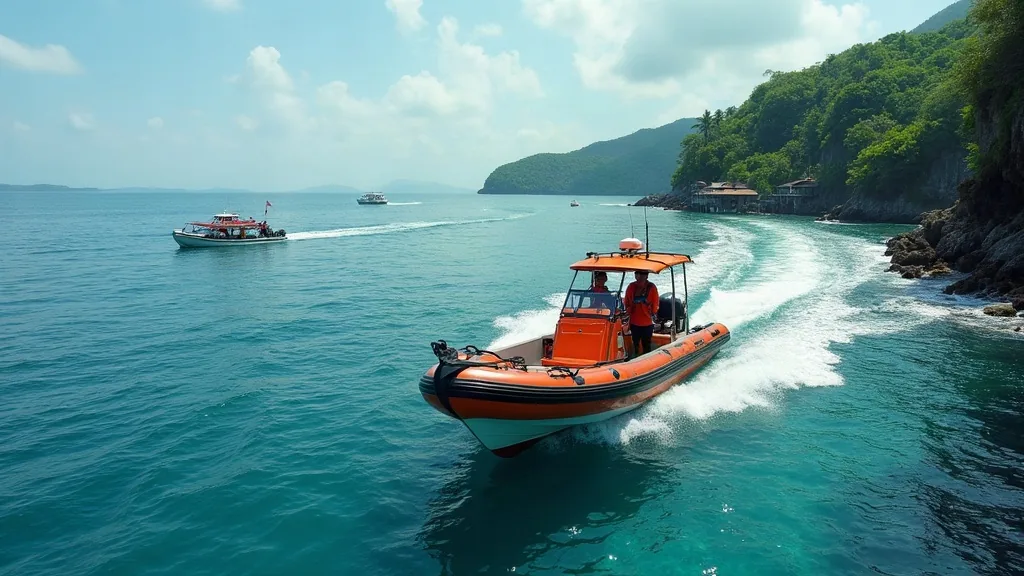
A liveaboard medical case moves in three legs: the crew stabilizes on board and calls the coordination desk, a tender or evacuation vessel runs the patient to Labuan Bajo (LBJ), then a road or air handoff carries the case to a hospital in Labuan Bajo, Denpasar, Jakarta or — for stable international cases — Singapore. Boat time from anchorage to LBJ runs roughly 20 minutes to over three hours depending on where in the park the vessel is anchored.
Komodo National Park has no dedicated marine medevac service. Indonesia’s 2024 air medical evacuation readiness study found no single regulation definitively governs medevac procedure or stakeholder coordination nationwide, which is exactly why a liveaboard captain needs one phone number to call rather than five agencies to guess between. Indonesia Medevac is that single point of contact for boats operating in Komodo waters: an independent coordination desk, not a boat operator, not a hospital, not an airline.
What is the sequence from boat to Labuan Bajo (LBJ) airport to tertiary hospital?
- On board — the dive guide or captain applies first aid, logs vitals and the GPS anchorage, and calls the desk’s active-case WhatsApp line.
- Assessment — the desk asks for symptoms, dive profile if relevant, anchorage zone and weather, then decides tender, chartered speedboat, or helicopter.
- Transfer to LBJ — the vessel runs to Labuan Bajo’s Komodo Airport (LBJ) area or the nearest jetty with road access to a receiving hospital.
- Hospital handoff — Labuan Bajo’s regional hospital stabilizes or treats; if the case needs a higher level of care, the desk books the onward flight while the patient is still in transit.
- Onward booking — for international cases, the desk pre-notifies the receiving hospital in Bali, Jakarta or abroad so the bed and specialist are ready on arrival.
Fit-to-fly assessment follows the framework in Decree of the Minister of Health 882/Menkes/SK/X/2009, which sets out medical evacuation guidelines and the roles of flight doctors, air nurses and assistants — the desk does not clear a patient to fly, the treating physician does. For flights that qualify as medical evacuation, Transport Regulation PM 66/2015 Article 16 exempts certain approval steps that apply to other flights, which is one reason a genuine medevac charter can move faster through flight-approval channels than a routine charter.
When does a fast tender beat waiting for a helicopter?
Helicopter evacuation from operators active in eastern Indonesia is daytime-only — Indo Jet Medic, one of the providers active in the region, states helicopter evacuation runs 06:00 to 18:00 local time. A case that occurs at night, at dusk, or in poor weather over the park is a boat case by default, not a helicopter case, regardless of urgency. A fast tender also wins when:
- The vessel is already inside 90 minutes of LBJ by water.
- Sea conditions are calm enough that boat transfer is faster end-to-end than waiting for a helicopter to be tasked, fuelled and flown in.
- The case is stable enough to tolerate a boat ride but the anchorage has no safe helicopter landing or hoist point nearby.
Helicopter tasking only outruns a tender on distance — the south and outer-park anchorages, and only during daylight hours with a landing zone confirmed in advance.
Anchorage-to-Labuan Bajo boat time bands (indicative)
| Park zone | Example anchorages | Fast tender time to LBJ |
|---|---|---|
| North Komodo | Gili Lawa, Batu Bolong, Siaba | Approx. 45 min – 1.5 hr |
| Central Komodo | Komodo Island, Pink Beach, Manjarite | Approx. 1 – 2 hr |
| South Komodo / Rinca | Loh Buaya, Nusa Kode, southern Padar | Approx. 1.5 – 3+ hr |
Bands are indicative and depend on vessel speed, sea state and exact anchorage; they are not a guaranteed transit time.
Which onward destinations make sense for divers, cardiac cases and trauma?
- Diving injuries (suspected DCS, arterial gas embolism): routed to the nearest facility with hyperbaric capability that the receiving physician confirms can take the case; this is decided case by case at the point of referral, not pre-assigned.
- Cardiac cases: if stable for fixed-wing transport, Denpasar’s tertiary hospitals are the usual first stop; unstable or specialist cases continue to Jakarta.
- Trauma: Labuan Bajo stabilizes first; onward transfer depends on injury severity and what imaging or surgical capacity the case needs.
- International repatriation: for patients whose home country or insurer requires it, the desk coordinates onward movement toward Singapore, Kuala Lumpur, Bangkok or, for Australian nationals, the Darwin, Brisbane or Sydney network that providers such as CareFlight Australia operate on regular Bali and Jakarta medevac routes. Routing to Penang follows the same logic as other regional hubs by market practice, though Indonesia Medevac has not documented a fixed Penang route.
Onward flight matrix from LBJ (indicative, as of 2026)
| Route | Typical aircraft class | Indicative flight time |
|---|---|---|
| LBJ → Denpasar (Bali) | Commercial with stretcher kit, or air ambulance charter for critical cases | Approx. 50 min |
| LBJ → Jakarta (Halim or Soekarno-Hatta) | Charter for critical cases; commercial stretcher for stable cases | Approx. 2 hr |
| LBJ → Singapore | Fixed-wing air ambulance, usually transiting Denpasar or Jakarta | Multi-leg; total transit varies by case and slot availability |
Every leg above is booked case by case; times are planning bands, not a schedule the desk guarantees.
What paperwork does an insurer want from a boat captain?
Assistance companies and insurers move faster when the vessel hands over a complete packet at first contact:
- Passenger/crew manifest with the affected guest identified
- Dive log or dive computer download if the case is dive-related
- Time-stamped incident report and vitals log from onset
- GPS anchorage position and park zone at time of incident
- Copies of passport/ID and travel or dive insurance policy number
- Next-of-kin contact details
This is also the packet the desk asks for when a boat registers in advance — the fewer questions asked mid-emergency, the faster activation moves.
Standby registration for charter operators
Territory note: Bali-mainland transfers are handled by the sister desk at balimedevac.com. Indonesia Medevac holds the national and international onward legs — the moment a case leaves Labuan Bajo for Denpasar, Jakarta or overseas, this desk owns coordination.
| Registration option | What it covers | Duration | Indicative cost |
|---|---|---|---|
| Per-trip standby | Manifest and medical-kit review, activation on call for one charter | Length of the specific trip | Quoted case-by-case in USD/IDR by the activated operator |
| Seasonal standby | Same coverage, priority activation across the peak season | Typically April–October | Quoted case-by-case, negotiated per fleet |
| Active-case coordination | Live activation, hospital liaison, onward booking and insurer paperwork | Per case, from first call to hospital handoff | Set by the operator dispatched to the case, shared before departure |
No public dated tariff table exists for medevac in Indonesia; every figure above is set by the licensed operator activated for that case, communicated before dispatch, and confirmed in writing once the desk has the case details.
How activation works
- Register the vessel before the season or the trip — manifest, medical kit list, and emergency contact on file with the desk.
- Call the active-case line the moment a medical event occurs; give anchorage, symptoms and vitals.
- Desk assesses and dispatches the fastest safe option — tender, chartered boat or daytime helicopter — and notifies the receiving hospital.
- Onward leg booked in parallel if the case needs Denpasar, Jakarta or international transfer, so the flight is arranged while the boat is still en route to LBJ.
- Paperwork closed out with the insurer or assistance company using the manifest and incident log already on file.
Indonesia Medevac is an independent broker and coordination desk operated by Juara Holding Group since 2015. It does not own vessels, aircraft or hospitals; it arranges every leg through licensed operators and does not claim ratings, awards or outcomes on their behalf.
Register a vessel or activate a case: WhatsApp the concierge desk at (https://wa.me/6281139414563) or email bd@juaraholding.com. Have the manifest and anchorage ready — that alone cuts minutes off the first call.
Frequently Asked Questions
Does travel insurance need to be arranged before the liveaboard departs, or can Indonesia Medevac register a boat mid-trip?
Registration works best before departure so the manifest and kit list are on file, but the desk can still take an activation call from a boat that never pre-registered. Pre-registration only speeds up the first response; it is not a condition for the desk to help during an active case.
What happens if a case occurs in a national park zone with no phone signal?
The crew should move toward the nearest point with signal or use the vessel’s satellite communication if fitted, then call the desk as soon as contact is possible. Many liveaboards carry satellite phones for exactly this reason; the desk cannot dispatch until it has the anchorage and case details.
Can a liveaboard operator register once for an entire season instead of per trip?
Yes — seasonal standby registration covers a fleet or vessel for the peak season, typically April through October, instead of re-registering before every charter. The operator still submits an updated manifest per trip, but the emergency contact and kit review stay on file for the season.
Is a decompression sickness case evacuated differently from a cardiac or trauma case?
The transfer to LBJ follows the same tender-or-helicopter decision, but the onward hospital choice differs — a suspected DCS case is routed to a facility the treating physician confirms has hyperbaric capability, while cardiac and trauma cases go to the nearest tertiary hospital equipped for that injury type. The desk does not pre-assign a hospital; the receiving physician confirms capacity first.
Who pays for the evacuation if the patient has no travel insurance?
The desk still coordinates the case, but without insurance the guest or the liveaboard operator is billed directly by the operator dispatched, at the rate that operator quotes for that trip. This is why Indonesia Medevac recommends every guest carry evacuation-inclusive travel insurance before boarding a Komodo liveaboard.